Monday, April 20, 2015

Cordova, Alaska: DIY Fly Fishing Salmon

I have done several DIY fishing trips to Alaska. I have yet to do a DIY fly-in/fly-out in Alaksa, but I have fished from Prudhoe Bay to Homer; and from Anchorage to the border of Canada (Yukon). Based on my experience, the most popular DIY fishing destination is the Kenai Peninsula; it's also the most crowded.  If you are looking for a less crowded DIY experience, and if you are targeting Sockeye and Coho Salmon, I would highly recommend visiting Cordova, Alaska.


100% Cordova DIY Silver. Be ready for EPIC battles!

Skip the Crowds: Why DIY Cordova?

1.  As popular as it is, Cordova will always be less crowded because it is only accessible by sea and air. Alaskan airlines operates out of the main airport in Anchorage.  It's a short 45 - 60 minute flight. The ferry service operates out of Whittier Harbor, which is about 1.5 hours drive time from Anchorage. The ferry services both passengers and autos.  The auto service is key for those traveling in campers/RV's.  The passage takes about 3 hours. For more information, please visit the following links:


2.  There are +/- 2,000 people living in Cordova; it's a small coastal community with lots of history and charm. You'll have plenty of lodging options and a very small handful of restaurants.  In other words, you'll be comfortable in town, but you are only minutes away from very wild land and water.

3. Fishing!  Within minutes of town, you can DIY fish Lake Eyak, Eyak River, Ibeck Creek, Alaganik Slough, and Fleming Lagoon.  On the Eyak (lake & river), you can rent boats or hire a guide boat. If you like ocean sport fishing, you can charter a boat and target salmon, halibut, and more.

NOTE:  I targeted Ibeck Creek because the coho run was HOT.  I checked out the other areas mentioned above, but the fishing was slow/poor.  FYI:  I only write about water that I personally fish.

What a day...What a Creek!

Ibeck Creek Facts    

  • Length:  The creek is splintered.  It's hard to determine the exact miles of the creek.  I think it's fair to say the creek is several miles long, in either direction.  
  • Origin: Copper River System Drainage.
  • Termination: Pacific Ocean.
  • Location: 7 mile bridge. Take highway 10 (Copper River Highway). It's impossible to get lost. In the Cordova area, seven mile bridge is the most accessible fishing spot (it gets busy). 
  • Fishing Season: Fishing is available year round, but please review regulations at http://www.adfg.alaska.gov/index.cfm?adfg=license.main
  • Floating: No.
  • Dangerous Animals:  Be prepared to encounter BEARS!
  • Walk-Wade Difficulty:  Easy. Water is very cold. 
  • Weather:  Cordova is known for rain.  Come prepared!
  • Fly Rods: Single Hand 7wt - 10wt.  Two handed rods (switch-spey) 6wt - 9wt.
  • Fly Lines: Floating and Sinking Tips.
  • Fishing Tips:  If you fish the bridge, be prepared for people.  If you want the creek to yourself, walk  +/- 30-60 minutes up or down the creek.  Simply explore and you'll find fish. 
  • Leaders-Tippets:  We don't use tapered leaders.  10lbs - 20lbs monofilament, about 4ft long, tied to sink tips (if you are targeting large King Salmon, you may need 40lbs monofilament line and a 10wt rod).
  • Coho Flies:  Coho will take both streamers and top-water flies.  Focus on various articulated leach patterns, with/out dumbbell eyes; large-long buggers; Popper Wogs; Gurglers.
  • Special Note: The creek is usually 100% crystal clear water (other waters in Cordova are glacial color).  This means you can see the Coho salmon.  It also means they can see you.  You can stalk/target fish and watch the fish strike your fly, with either streamers or top water flies. Some Coho's are very aggressive and will follow your fly, before attacking it. My point, typically Pacific Salmon fishing is all about snagging fish, but not with Coho's.  This is 100% fun, and the most technical salmon fishing possible on this great earth.  

Anadromous Runs

  • June - July : King Salmon.  Peak = June - July
  • June - August: Sockeye Salmon.  PEAK =  June - July
  • June - August: Pink Salmon.  PEAK =  June - July
  • June - August: Chum Salmon. PEAK = June -  July
  • August - September: Coho Salmon. PEAK =  Mid August thru Mid September
  • Year Round: Dolly Varden.  PEAK = June - July
  • Year Round: Rainbow Trout.  PEAK =  June - August
  • Year Round: Cutthroat.  PEAK =  May - June.

NOTE: The Cordova area has King Salmon fishing, but that is usually done in the ocean.  The majority of the King Salmon spawn in the Copper River, not the rivers in Cordova.

DIY Global Fishing Trips

At FCFF, I am running a business, but sometimes I love DIY fishing with friends. If you want to fish with me on one of my personal DIY trips, let's talk.

Smoked Candy Salmon 
Salmon Pizza

Final Word

In just four days of fishing, I caught, processed and packed 50lbs of wild Coho Salmon.  From Anchorage, I shipped my fish to New Hampshire, overnight, for $275.00 USD.  For the next several months, each time I ate salmon, I reflected on my DIY experience in Cordova.  Deep personal satisfaction does not even begin to describe my feelings. One thing is true, I am extremely thankful for this experience, and I highly recommend it to all my fellow DIY anglers.

Hope you enjoyed this post and thanks for reading.

Mark.


Sunday, April 19, 2015

Costa Rica: Fly Fishing Lake Arenal

The next time you head to Costa Rica, you may want to pack your fly rod. Costa Rica has more than a handful of rivers and lakes, that hold cold and warm water species. If you are in the La Fortuna area, you may want to wet a line in Lake Arenal.  This is Costa Rica's largest lake and offers some good fishing on the fly and scenic views of volcan Arenal.

Toothy Macha

A good fight on a 5wt or 6wt.
Large male Guapote.  

Lake Arenal Facts    

  • Length:  30 kilometers.  About 5 Kilometers wide.
  • Depth:  Up to 200 feet.
  • Origin: Man made lake to create hydro power.  Lake was made in the 1970's. 
  • Location: Principal town is La Fortuna, Cost Rica. 
  • How to get there: Most people fly into San Jose and then take a bus or rent a car. Depending on San Jose traffic, it could take 3-5 hours. 
  • Fishing Season:  Year round. December and January can be a tad slower.
  • DIY Option:  There are places you could fish from the shore, but productivity is questionable. If you are adventurous, you could rent a kayak and search for good fishing spots.
  • Guides:  In the area, there a small handful of guides.  I fished with, and highly recommend Captain Ron at http://arenalfishing.com/ 
  • Licensed Required: None that I know of.  
  • Resident Species: Guapote and Machaca. 
  • Fly Rods: Single hand 5wt - 8wt.  It can get windy on the lake.
  • Fly Lines:  WFF. +90% of the fish will take flies on the surface.
  • Technical Fishing:  Cast to the shore/weeds.
  • Leaders-Tippets:  6.0 ft-7.5 ft 0X-1X.
  • Flies: Gurglers with legs; Fat Albert; various poppers; Chernobyl Ant.
  • Hook Size:  Try various sizes #02 - #10.

DIY Global Fishing Trips

At FCFF, I am running a business, but sometimes I love DIY fishing with friends. If you want to fish with me on one of my personal DIY trips, let's talk.

Throughout the year, you have only a 50% chance of seeing volcan Arenal. 100% chance of great day on a beautiful lake.

Final Word

If you come to Costa Rica, chances are you'll make a stop in the La Fortuna and Lake/Volcan Arenal area. You'll find multiple tour packages such as rafting, ATV, hiking, horse rentals, canyoning, hot pools, water falls, canopy zip line, and lots more.  Lodging options ranging from $ to $$$$.  I stayed in town for $35 USD per night, with breakfast and views of the volcano included.

Adding a 1/2 day or full day fishing trip on lake Arenal might be a nice alternative to the ever popular tours, and crowds of tourist.  I had the entire lake to myself and enjoyed every minute of it.

Hope you enjoyed this post and thanks for reading.

Mark


Friday, April 17, 2015

Bella Coola River: British Columbia DIY Fly Fishing

The purpose of this post is to share DIY fishing information about the Bella Coola River, located in Bella Coola, British Columbia.

When I think of all the DIY trips I have taken, this was my best.  Why? In the early A.M. I fished for salmon on the Bella Coola River and during the evening, I fished for trout on the Atnarko River. The animal life was amazing; I saw eagles, bears, wolves, and moose. I visited the salmon hatchery and they allowed me to participate in fertilization of salmon eggs. I saw some of the most scenic mountains I have ever seen in my life.  Each night, I slept in my rental van, next to the river, and no one ever bothered me or asked me to move. The town of Bella Coola and Hagensborg are extremely small, and offer enough to live a very simple, yet fulfilling life.  Most importantly, the ability to fish for wild fish, both in the Bella Coola and Atnarko rivers (the other local river), is amazing.

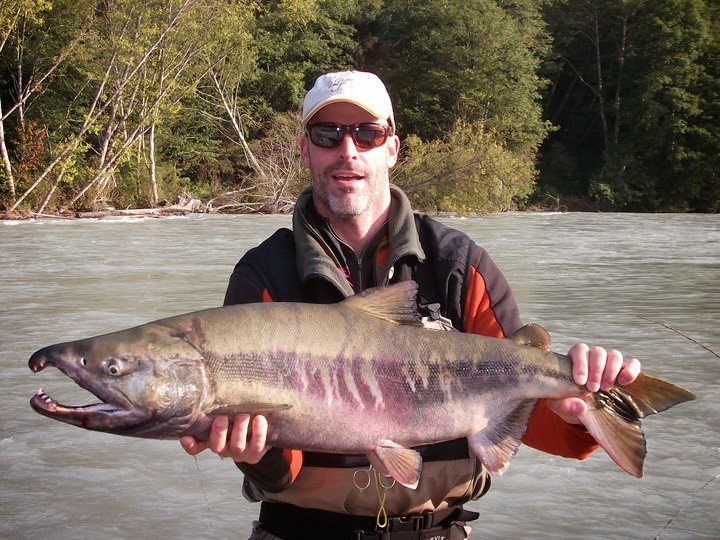
Chum Salmon: When I tell you do not let the fish swim out into the main current it's because these fish are big, strong and the current is moving fast = even in slow water, this is a hell of a fight.


River Facts    

  • Length:   43.5 miles, draining an area of 1,934 square miles.
  • Origin: Atnarko and Telchako Rivers join to form the Bella Coola River.
  • Termination: Pacific Ocean (fjord).
  • Location: Bella Coola, British Columbia.  
  • How to get there: Between 13-20 hours driving time from Seattle, WA., USA.  You can fly from Vancouver (south terminal airport) on http://www.pacificcoastal.com/  On Vancouver Island, at Port Hardy, you can take a passenger/auto ferry, http://www.bcferries.com/schedules/discovery/
  • Fishing Season: Best fished during the spring, summer and fall.  Please review regulations at http://www.fishing.gov.bc.ca/
  • Licensed Required: Yes. Contact  http://www.fishing.gov.bc.ca/
  • Dangerous Animals:  Be prepared to encounter BEARS!
  • Species: Sean run Cutthroat, Dolly Varden, King Salmon, Pink Salmon, Sockeye Salmon, Chum Salmon, Coho Salmon.  According the BC Parks, Steelhead are in the river.
  • Float: Yes. Local guides drift the river.
  • Walk-Wade Difficulty:  Water is cold.  Fish from shore and wade into water, where conditions are safe!
  • Fly Rods: Depends on target specie, but single hand 8wt - 10wt.  Two handed rods (switch-spey) 7wt - 9wt.
  • Fly Lines: Come prepared with a variety of sinking lines (full and sink tips).  The use of various grain weights depends on the flow and depth of the water. You can expect to use 300 grain up to 600 grain sinking line.  
  • Weights:  If you don't use sinking lines, you could bounce weight off the bottom.  This is only done is fast currents. 
  • Technical Trout Fishing:  Oddly enough, the fish are generally very-very close to shore. Cast across and swing line downstream and hang on (I am dead serious... do not let the salmon run into the main current). 
  • Leaders-Tippets: 2ft - 4ft section of15lbs - 30lbs mono (no leaders). 
  • Flies: Salmon hooks for each specie, and pink yarn.  Snell the yarn to the hook and start fishing.

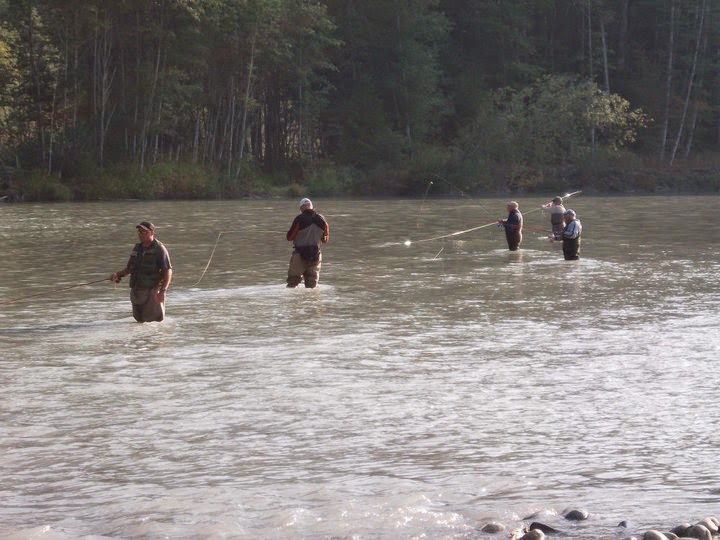
A great group of locals who have fished this river for +20 years.  They shared helpful tactics and best locations.  It looks crowded, but these were the only anglers I saw in 7 days.  Plus,  angling ethics are the rule, not the exception.  In other words, we fished on a rotation system and everyone caught fish.   


Anadromous Runs

  • April - May: Sean Run Cutthroat
  • May - July: King Salmon
  • July - August: Pink Salmon
  • July - August: Sockeye Salmon
  • August - October: Chum Salmon
  • September - October: Coho Salmon


DIY Global Fishing Trips

At FCFF, I am running a business, but sometimes I love DIY fishing with friends. If you want to fish with me on one of my personal DIY trips, let's talk.


Final Word

I spent seven days in Bella Coola and enjoyed every second. I will return some day and spend more time on the river.  Lodging options vary from DIY camping, paid camp sites, cabins, B&B's, lodges and small family run hotels.  Small grocery stores and a few restaurants will provide plenty of food to keep the DIY angler alive.

If you travel to Bella Coola and would like information on fishing spots, give me a shout or contact Markus Schieck at Tweedsmuir Travel  http://www.tweedsmuir-travel.com/  Markus is an avid fly fisherman and will gladly provided you with local river information.  (also, he's the booking agent for the BC Ferry system and can assist your with local lodging options).  Bella Coola is not what I would call family friendly (i.e. no water-parks, ice cream stands, movie theaters, video arcades, playgrounds, etc).  But, if I had to choose a place to live and DIY fish for salmon and trout, it would be on the top of my list.

Hope you enjoyed this post and thanks for reading.

Mark.

Atnarko River: British Columbia DIY Fly Fishing

The purpose of this post is to share DIY fishing information about the Atnarko River, located in Bella Coola, British Columbia.

When I think of all the DIY trips I have taken, this was my best.  Why? I fished for salmon and trout in the same day, with no pressure from other anglers.  The animal life was amazing; I saw eagles, bears, wolves, and moose. I visited the salmon hatchery and they allowed me to participate in fertilization of salmon eggs. I saw some of the most scenic mountains I have ever seen in my life. Each night, I slept in my rental van, next to the river, and no one ever bothered me or asked me to move. The town of Bella Coola and Hagensborg are extremely small, and offer enough to live a very simple, yet fulfilling life.  Most importantly, the Atnarko river has miles of accessible water and is loaded with trout and salmon.

The structure and hydraulics of the Atnarko are amazing.  You could fish this river for an entire life and not get bored. 

River Facts    

  • Length:  62 miles.
  • Origin: Charolette Lake. It flows west for about 62 miles, until it joins the Telchako river to form the Bella Coola River.
  • Termination: Pacific Ocean.
  • Location: Bella Coola, British Columbia.  
  • How to get there: Between 13-20 hours driving time from Seattle, WA., USA.  You can fly from Vancouver (south terminal airport) on http://www.pacificcoastal.com/  On Vancouver Island, at Port Hardy, you can take a passenger/auto ferry, http://www.bcferries.com/schedules/discovery/
  • Fishing Season: Best fished during the spring, summer and fall.  Please review regulations at http://www.fishing.gov.bc.ca/
  • Licensed Required: Yes. Contact  http://www.fishing.gov.bc.ca/
  • Floating: You can hire local guides to float, but you can walk-wade the Atnarko.
  • Dangerous Animals:  Be prepared to encounter BEARS!
  • Resident Species: Rainbow Trout, Cutthroat, Bull Trout.
  • Anadromous Species: Sean run Cutthroat, King Salmon, Pink Salmon, Sockeye Salmon, Chum Salmon, Coho Salmon.
  • Walk-Wade Difficulty:  Water is cold.  Crossing the river is extremely difficult.  Fish from shore and wade into water, where conditions are safe.
  • Fly Rods: Depends on target specie (trout or salmon), but single hand 6wt - 10wt.  Two handed rods (switch-spey) 6wt - 9wt.
  • Fly Lines: The variety/structure of water is unimaginable.  Come prepared with floating and a variety of sinking lines. 
  • Technical Trout Fishing:  This is not your ordinary trout river.  Anglers accustomed to fishing nymphs and streamers in deep, fast water will do well.  Admittedly, I did not prepare well for this fishing trip, but I got the job done with what little equipment I had. I used wet-flies (nymphs) and streamers (wooly buggers) and spent most of my time swinging and dead-drifting, with class V sinking line (160 grains). If I wanted to go deeper, which I did,  I simply cast up stream and at the end of the down-swing, I used an arc/lift presentation (it worked).  On my next visit, I would be tempted to use my Patagonia Tango Nymph Rig or other deep water, tight-line nymph techniques. More info about Nymph Rigs: http://firstcastflyfishing.blogspot.com/2015/01/fly-fishing-patagonia-argentina-tight.html
  • Leaders-Tippets:  Chances are, you'll be fishing for both trout and salmon.  As such, you'll need to variety leaders and tippets. 
  • Trout Flies: Though I saw plenty of fish rising, I did not have much luck with dry flies. I used a variety of nymphs and streamers, and fished them at multiple depths.  The most success I had was with a #10 Zug Bug and #04-#08 Wooly Bugger.  

I was nymph fishing for trout and caught two of these. 

Anadromous Runs

  • April - May: Sean Run Cutthroat
  • May - July: King Salmon
  • July - August: Pink Salmon
  • July - August: Sockeye Salmon
  • August - October: Chum Salmon
  • September - October: Coho Salmon

Average Atnarko Rainbow Trout. 


DIY Global Fishing Trips

At FCFF, I am running a business, but sometimes I love DIY fishing with friends. If you want to fish with me on one of my personal DIY trips, let's talk.


Final Word

I spent seven days in Bella Coola and enjoyed every second. I will return some day and spend more time on the river.  Lodging options vary from DIY camping, paid camp sites, cabins, B&B's, lodges and small family run hotels.  Small grocery stores and a few restaurants will provide plenty of food to keep the DIY angler alive.

If you travel to Bella Coola and would like information on fishing spots, give me a shout or contact Markus Schieck at Tweedsmuir Travel  http://www.tweedsmuir-travel.com/  Markus is an avid fly fisherman and will gladly provided you with local river information.  (also, he's the booking agent for the BC Ferry system and can assist your with local lodging options).  Bella Coola is not what I would call family friendly (i.e. no water-parks, ice cream stands, movie theaters, video arcades, playgrounds, etc).  But, if I had to choose a place to live and DIY fish for salmon and trout, it would be on the top of my list.

Hope you enjoyed this post and thanks for reading.

Mark.

PS. Read more about this trip at http://firstcastflyfishing.blogspot.com/2010/09/fist-cast-fly-fishing-expedition.html

Monday, April 13, 2015

Costa Rica: DIY Trout Fly Fishing

The next time you head to Costa Rica, you may want to pack your trout rod.  Surprisingly, Costa Rica has a handful of rivers that hold beautiful Rainbow Trout.  The most popular river is the Rio Savegre. The river is located in a small village called San Gerrado de Dota.  It's an easy drive from San Jose and is a well known destination, with a variety of lodging options.  Speaking of lodging, I stayed at Los Lagos Lodge for $60 USD per night, including three wonderful meals per day. Wifi available in main salon and email is loslagoslodge@costaricense.cr


Savegre River Facts
  • Length:  41 km total, but the trout section is less than 4 km.
  • Location: 2.5 hours from San Jose, Costa Rica. Take the Pan American Highway south, towards San Isidro.    
  • Fishing Season: Open year round.
  • Licensed Required: None that I know of.  
  • Floating: Walk-Wade Only.  White water rafting on the lower section. 
  • Species: Rainbow Trout from the McClould River, USA; and Canadian Kamloops. Hybrids are called Tico Trout. 
  • Average Size:  Expect fish to range from 6" to 10".  There could be a few larger fish, possibly up to 18".
  • Technical Fishing:  Casting can be challenging in densely wooded areas.  Nymphing plunge pools and fast micro-runs is an art; not many anglers do this on a daily basis. Fish are very spooky.  Be patient. Focus on slow steady body movements and maintain calm breathing.  Let the nymph sink to the bottom as quickly as possible; if you can, keep you fly line off the water; lead the leader through the pool/run, begin to life slowly = FISH! 
  • When:  Any time of year.  Rain season runs May - November.
  • Origin: 3,941 meters, Cerro de la Muerte, in the Cordirilla de Talamanca. 
  • Termination: Pacific Ocean.
  • Walk-Wade Difficulty:  Water is cold.  Depending on air temps, waders may be optional. Walking is not difficult.  
  • Fly Rods: 1wt- 5wt.  (I used my 5wt because that is all I had). 
  • Fly Lines:  Floating.  
  • Leaders-Tippets: I used a 14ft leader, ending with 6X tippet. Anything below 6X is too large. 
  • Flies:  The fly selection is not complicated. Think small, #16-#20.  Traditional small dries and nymphs.
  • Dangerous Insects and Animals:  No poisonous snakes or blood sucking bugs.  Climate is cool and temperate.  

Other Trout Rivers in Costa Rica
  • Chirripo
  • Toro
  • General
  • Lower Tapanti
  • Providencia (middle section of Savegre)
  • Orosi

NOTE: These rivers are not as accessible as Rio Savegre.  They are known to hold larger fish, but if your vacation time is limited, Savegre is the river of choice.

Day 01: 1st Costa Rican Rainbow Trout.  I missed a dozen or more strikes on the dry.  When I switched to a nymph, I caught a couple of dozen. 
Day 02: Fished all day long with nymphs (Red Copper John, Hare's Ear).
Day 02:  Largest fish of the day.

DIY Global Fishing Trips

At FCFF, I am running a business, but sometimes I love DIY fishing with friends. If you want to fish with me on one of my personal DIY trips, let's talk.

Final Thoughts

If you are like me and love fly fishing small intimate rivers, you may want to visit Rio Savegre. I think one or two days is plenty of fishing time here.  Plus, it's a nice break form the heat-humidity of the coast and it's far away from the tourist crowds.  

I hope you enjoyed this post.  Thanks for reading.  

Mark