Sunday, November 16, 2014

Fly Fishing New Hampshire: Pemigewasset River

How to use this blog?  Use the blog search engine and type in key words such as Float Trip, Walk-Wade, Float Tube, Lessons, Pesos, Fy Rods, Lodging, Food, Wine, Flies, Best Months, etc.  The search engine is located on the right side, just below the weather.  FYI, there are over 100 post about fishing Patagonia...the information you are looking for, is probably on this blog. Thanks.


Pemigewasset (Pemi) River Facts

Length: 65 miles.
Origin:  Profile Lake, located in Franconia Notch State Park.
Termination:  In Franklin, New Hampshire, the Pemi merges with the Winnipesaukee River to form the Merrimack River.  The Merrimack flows to the Atlantic Ocean, ending in Newburyport, MA. 
Location:  Starting in Franconia and ending in Franklin, the Pemi runs along highway 93 and route 3. The river travels through much of the white mountains. 
Tributaries:  Smith, Newfound, Squam, Baker, Beebe, Mad, Lost, East Branch Pemigewassett.
Fishing Season: January 01 to October 15th. Please see special rules http://www.eregulations.com/newhampshire/fishing/freshwater/rivers-streams-with-special-rules/
Licensed Required: Yes, general fishing only. 
Floating:  Yes, for sport and recreation.  There are a few businesses that offer kayak, canoe and tube rentals.  The entire river is classified as a non-technical, easy river to float.  However, be aware of dams and falls. More technical information is available at https://www.americanwhitewater.org/content/River/detail/id/3735/
Walk-Wade: Yes.  From Profile Lake to Franklin, there are many pull-offs.  
Entrance Fee: No.
Camping & Lodging: Yes, there are many private and public camping options.  
Depth:  Not known as a deep river.  Greatly varies due to the structure of the river and dams.
Access:  Extremely accessible by boat or foot.  North of Plymouth, NH, I tend to favor walk-wade access points along route 3 and 175. 

For 20 years, NH attempted to restore Atlantic Salmon to the Pemi and Merrimack River Watershed.  In 2014, the program was cancelled.  To think, before dams, this tremendous specie swam freely in the Live Free or Die state.  Photo courtesy of NH Fish & Game. 


Why Fish the Pemigewasset River 
    
  • Native Species:  Eastern Brook Trout, Atlantic Salmon and Fall Fish (chub).
  • Non-Native Species: Rainbow, Brown Trout, Small Mouth Bass, Blue Gill, Yellow Perch.
  • Stocked Fish:  NH Fish & Game stocks EBT, and Rainbow and Brown Trout.  NH Fish & Gamed used to stock Atlantic Salmon, but the program has been cancelled.
  • Structure: Varies greatly.  Due to dams, the Pemi has long runs of slow shallow water.
  • Location: Much of the Pemi runs through the white mountains of New Hampshire. 
  • Communications:  You'll have good cell service throughout the river system.
  • Experience:  In my opinion, of all the rivers in New Hampshire, and despite human influences (e.g. dams), the Pemi feels like a big wild river.  There are stretches of this river that are wild and beautiful.
  • Scenery:  The combination of mountains, tree's and blue sky is hard to beat.  Seasonal colors are good, especially in the fall. 


How to Fish the Pemigewasset River

Please visit http://firstcastflyfishing.blogspot.com/p/lessons-guiding_22.html

Final Word

I have a love, hate relationship with the Pemi.  I love the Pemi because there are stretches that feel very wild, very beautiful, and very soulful.  For a fisherman, these stretches have some of the most tantalizing waters in all of New England.  Specifically, some stretches of the Pemi look as though they would hold an abundance of trophy fish, but they don't.  To understand why the Pemi does not hold/sustain trophies such as the Atlantic Salmon, I encourage you to read a book written by a New Hampshire author, Jack Noon. http://www.amazon.com/Fishing-New-Hampshire-History-Series/dp/1893863026

I hate the Pemi because of what it once was; a very wild river filled with an abundance of wild fish. Correction, I don't hate the river. I hate the fact that humans chose to destroy something very wild.

Thanks for reading.  I hope you enjoyed this post.

Gone Fishing,

Mark

Fly Fishing New Hampshire: Mad River

How to use this blog?  Use the blog search engine and type in key words such as Float Trip, Walk-Wade, Float Tube, Lessons, Pesos, Fy Rods, Lodging, Food, Wine, Flies, Best Months, etc.  The search engine is located on the right side, just below the weather.  FYI, there are over 100 post about fishing Patagonia...the information you are looking for, is probably on this blog. Thanks.


Mad River Facts

Location:  Campton and Waterville Valley NH area.  Google Maps: https://goo.gl/maps/ufK4y
Fishing Season:  General Rules; January 01 to October 15th. 
Licensed Required:  Part of the Mad River is within the boundaries of the White Mountain National Forest. Throughout our nation, you don't need a fishing license to fish in national parks (please double check this info).  If your not fishing in the national forest, you will need to purchase a general fishing license. 
Floating:  No. This is a small stream.  Professional guide services and DIY (do it yourself).
Walk-Wade: Yes.  There are many sections for DIY walk-wade.  
Entrance Fee: No.
Camping:  Yes.  Think white mountain national forest camping areas, or private campgrounds.
Length:  17.9 Miles 
Origin:  Greeley Ponds, located in Mad River Notch. 
Termination:  Pemigewasset River. 
Access: There are plenty of pull-off's and access points.


Why Fish the Mad River 
    
  • Native Species:  Small Eastern Brook Trout. 
  • Non-Native Species: Rainbow and Brown Trout.
  • Stocked Fish:  NH Fish & Game stocks EBT, and Rainbow and Brown Trout.
  • Structure: A true mountain freestone river (think lots of boulders). Small plunge pools and pocket water created by large boulders. 
  • Location:  From the south,  it's an easy drive up interstate highway 93.  Get off the exit and practically start fishing.
  • Communications: You'll have service in/around the valley.
  • Experience:  In the lower section, in/around the valley, expect crystal clear water and a natural maze of boulders that have been smoothed by water and time.  Beyond the valley, as you hike and fish towards the source, expect thick forest and solitude (fish in this section are very small, but wild).

Stocked Rainbow Trout, caught on a 12ft Tenkara.


How to Fish the Mad River

Option A:  You could hire a licensed guide.  First Cast Fly Fishing and other guides service this river.

Option B:  DIY (Do it Yourself).  If you plan to fish  this section on your own, your best bet is:


  • In my opinion, the river no longer sustains a robust population of wild fish.  Therefore, if you want to increase your chances of catching decent sized fish, following the New Hampshire Fish and Game stocking reports.  
  • Overall, I tend to favor early season fishing. Be mindful of high water, due to snow melt. Typically, as summer approaches, and due to lack of rainfall, water warms and water flow can be low. During warm temps and low water, fish early A.M. and search for deep water and structure. 
  • Fly Rods: 1wt to 4wt should get the job done. I often use my 12ft Tenkara rod.  
  • Fly Line:  No need for sinking lines of any kind.
  • Techniques: You could use a streamer, but I believe this river is ideal for nymphs, and dry fly's (dry-dropper combo is ideal!) 

Final Word


When I have the desire to fish a mountain stream, and if I don't have a lot of time, the Mad River is my first choice. Why?  From my home in southern New Hampshire, this is a quick and easy drive.  I can fish all day, and even explore other nearby rivers, and then be home for dinner.

Thanks for reading.  We hope you enjoyed this post.

Gone Fishing,

Mark
Monday, November 10, 2014

Dry Dropper Combo: Quick, Easy, Effective

How to use this blog?  Use the blog search engine and type in key words such as Float Trip, Walk-Wade, Float Tube, Lessons, Pesos, Fy Rods, Lodging, Food, Wine, Flies, Best Months, etc.  The search engine is located on the right side, just below the weather.  FYI, there are over 100 post about fishing Patagonia...the information you are looking for, is probably on this blog. Thanks.

During peak summer months in Patagonia, the gold standard of fishing is the use of a dry-dropper rig. Whether you are walking-wading or floating, these rigs are extremely effective and easy to set-up. However, some anglers struggle with the set-up.  I think they struggle because they don't know how or they doubt their abilities to attach tippet to the bend of the hook.  When they attempt to attach the tippet, they use a technique that seems intuitive, but in real life application, it's awkward and not so efficient. To help you understand the techniques of adding a dropper, the goal of this post is to compare two styles of tying a dropper to the bend of the hook.

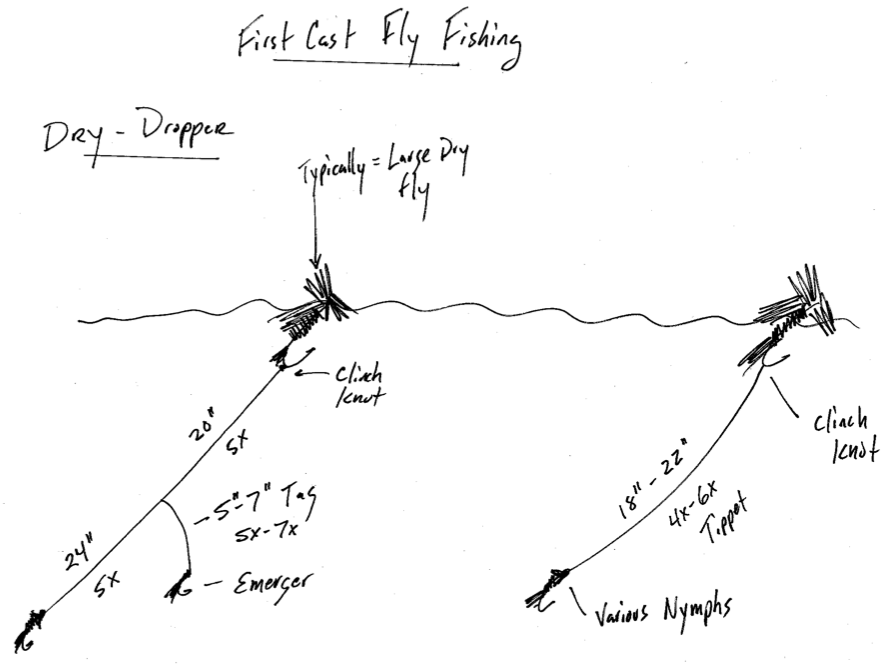
What is a dry-dropper rig? The below drawing shows that a dry-dropper rig is nothing more than a dry fly and trailing nymph(s).  The dry fly has two roles in this set-up:
  1. You may catch a fish with the dry fly.
  2. A large dry-fly acts as your strike indicator or suspension device. 
Personally, I have used this rig all over the world.  Why?  It catches fish!  Technically, I am dry fly and nymph fishing at the same time (i.e. think surface and sub-surface feeding).  In theory, the use of two flies increases my chances of catching fish (to a hungry fish, the combination of meat and potato's is hard to pass-up).  If you are not using this set-up, I strongly encourage you to start using it ASAP.  Experiment and see what happens.


Original Master Piece by Mark Foley :)


In the below video #1, I am demonstrating a technique that works, but is not the most efficient method of attaching a dropper to the bend. This technique seems highly intuitive, but in real life situations, it can be problematic.  Things to be concerned about:

  1. Safety:  The more time you spend holding the dry fly, the greater chance of sticking yourself.
  2. Hands:  You must keep one hand on the fly at all times.  Give it a try; you'll quickly understand why you wish you had a third hand.  
  3. Line-Finger Control:  The piece of tippet you are trying to wrap around the bend constantly slides off. To prevent this from happening, you must keep constant tension on the tippet, while it wrapped around the bend.  Bottom line, it takes a great amount of hand-eye coordination to master this technique (beginners get easily frustrated).
  4. Knots: new improved clinch is possible, but it's tough and takes practice. 
  5. Elements:  Add in +20 mph wind and enjoy this humbling, awkward experience. 

Video #1: Possible, but Inefficient Technique


The next diagram and video demonstrate an alternative dry-dropper technique.  Things to note:

  • Especially in video #1 technique, the use of clinch knot will enhance hand-eye coordination and make the process much easier/faster. 
  • Using an improved clinch knot is much easier in the video #2 technique.
  • You don't have to use your finger.  You might be able to use a gadget attached to your lanyard or vest.  Just make sure this gadget does not damage the line.
  • Before fishing, always test your knots; especially on a clinch knot.  Attach the bend of the hook to a solid device (e.g. finger loop on your hemostat) and test your knot. 


Another original master piece by Mark Foley :)

Video #2:  The Most Efficient Technique


Final Word

In both video's, I purposefully slowed down the instruction, or movement of my fingers.  I also tried to show how the line does not always cooperate; especially utilizing the improved clinch knot.  In time, and with practice/patience, your hand/finger coordination will greatly improve, and either technique will be performed much faster.  If your hand/finger coordination does not improve, don't sweat it; slow and steady always wins the race. If you're like most anglers, eventually you'll favor video/technique #2.

Hope you found this post helpful.

Thanks,

Mark